
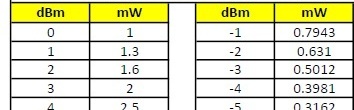
What are we looking at?
TL;DR: With Wi-Fi the reference power is 0 dBm which is 1 milliwatt. The scale is logarithmic, so every 3dB is a doubling of transmit power, and every +10dB is 10X the power. Likewise, -3dB is half power and -10dB is 1/10th the power. Here is a handy look-up table from -40 to +40 dBm just for quick reference.
See further below (after the conversion chart image) for a more complete explanation.

In Wi-Fi and RF, transmit power is usually expressed in dBm, which means decibels referenced to 1 milliwatt. So this is a logarithmic unit that references power relative to 1 milliwatt (mW). And it all starts with 0 dBm = 1 milliwatt as the starting point.
Since it is logarithmic, instead of increasing linearly, the dBm scale compresses a very wide range of power levels into more manageable numbers (like 0 to 30). This is especially useful in wireless systems, because signal levels can range from fractions of a milliwatt to multiple watts.
Because the scale is logarithmic, equal steps in dB represent multiplicative changes in power, not additive ones:
The rule of thumb is:
+3 dB = 2× the power
+10 dB = 10× the power
+20 dB = 100× the power
And in the opposite direction (perfectly symmetrical):
-3 dB ≈ ½ the power
-10 dB = 1⁄10 the power
-20 dB = 1⁄100 the power
Why do we care? Because small changes in dBm can represent large real-world power differences.
Suppose for example you increase transmit power from 17 dBm to 20 dBm. “Only adding 3dB” actually DOUBLED your actual RF output power. Looking at it another way (at the opposite end), a client transmitting at −30 dBm is operating at only 1 microwatt (1/1000th of 1 milliwatt) which is very small, even though number itself (-30) doesn’t look especially small.
This is why wireless engineers tend to think in dB steps rather than raw milliwatts. The math stays intuitive even though the power changes can be dramatic.
Note: By the way, if you want to create your own table in a spreadsheet, for the cells in column B, I simply used the formula =ROUND(10^(Axx/10),0) where Column A has the number sequence 1 through 40 and xx represents the row number.
For example, for 13 dBm in column A the cell in column B would be =ROUND(10^(A13/10),0) which calculates to 12.59 but for that column I wanted to round to the nearest milliwatt.
However, for the negative dBm part of the table, I used column D to range from -1 to -41, and for column E (milliwatts) I used =ROUND(10^(Dxx/10),4), and also added column F for microwatts using =ROUND(10^(D27/10)*1000,2).
No particular reason why I chose to round where I did, except to make the table easier on the eyes.
 Dave's Wi-Fi Blog